
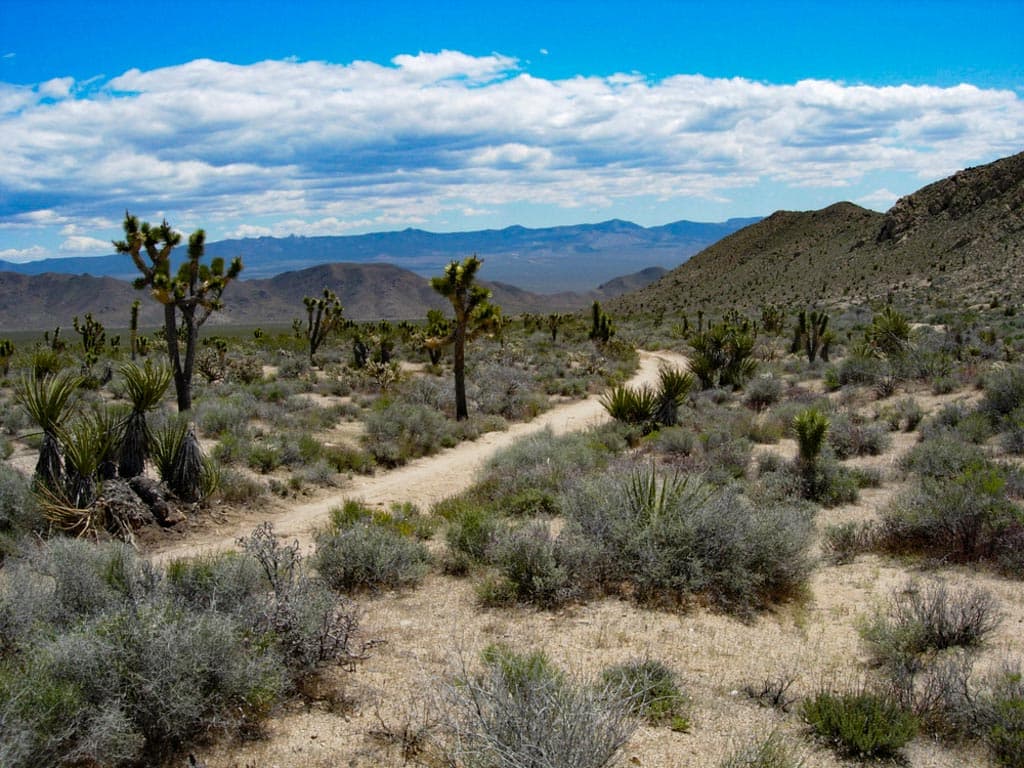
U.S. National Park Service (public domain)
The Mojave Road is a 150-mile historic overland route across the Mojave Desert in southeastern California, running east to west between the Colorado River near Laughlin, Nevada and Soda Dry Lake near Zzyzx. The route follows the original 1860s freight wagon road built to connect Fort Mohave on the Colorado with San Bernardino on the Pacific side, with stations and forts along the way to protect emigrants and supply trains.
Most of the route crosses unmaintained desert two-track and sandy washes within Mojave National Preserve. Drivers typically traverse the full road in two to three days. A four-wheel-drive vehicle is required for all but a few short paved stretches. ATVs, UTVs, and side-by-sides are prohibited. There are no fees and no services along the road.
Trailhead: 35.14000, -116.10500
- Technical Difficulty
- hard
- Length
- 150 miles
- Direction
- Point to point
- Vehicle
- Street-legal 4WD with high-clearance, recovery gear, and full water and fuel for two to three days. ATVs, UTVs, and side-by-sides are prohibited.
- Nearest town
- Baker, California
- Terrain
- Unmaintained dirt and sand across desert basins, dry lakebeds, and rocky passes
- Cell coverage
- None across most of the route
- Best months
- Oct, Nov, Dec, Feb, Mar, Apr
- Management
- National Park Service
- Also crosses
- Nevada
- Trailhead
- 35.14000, -116.10500
Resources
Directions
East to west (the typical direction). From Las Vegas, drive south on US-95 toward Searchlight and Laughlin. Cross the Colorado River into Bullhead City; the route's eastern terminus is at Beale's Crossing on the California side. From here the route runs west through Mojave National Preserve to Soda Dry Lake near Zzyzx and Interstate 15 at Baker.
West to east. From Los Angeles or Las Vegas, exit Interstate 15 at Zzyzx Road or Baker. The western terminus is on Soda Dry Lake.
Approximate western terminus coordinates: 35.140° N, -116.105° W.
Photos · 4
Getting Oriented
The Mojave Road sits in San Bernardino County, between Interstate 15 to the north and Interstate 40 to the south. Mojave National Preserve administers the central portion. Las Vegas is two hours northeast of the eastern access; the Los Angeles basin sits about three hours west of the western terminus near Baker. The route runs at elevations from 800 feet on Soda Lake to over 5,000 feet at Lanfair Valley.
Trail Overview
Drivers usually run the road east to west, starting at Beale's Crossing on the Colorado River near Avi and ending at Soda Dry Lake near Zzyzx. The eastern half climbs through Lanfair Valley, passes the stone ruins of Fort Piute, and crosses Cedar Canyon. The middle section runs through high desert past Marl Springs and the Cima Dome. The western half drops into Soda Lake and crosses the dry lakebed to Zzyzx and Interstate 15.
Surface conditions vary from packed dirt to deep sand, with rocky climbs through canyons and several wash crossings. Soda Lake floods after winter storms and can become impassable. Plan for two to three nights of camping along the way; a one-day push leaves no time for the historic stops that justify the trip.
Points of Interest
- Fort Piute. Stone ruins of an 1867 US infantry station built to protect the wagon road. Short rough spur off the main route.
- Marl Springs. Reliable water source used by the original wagon trains. Now a stop with cottonwoods and a stone-walled corral.
- Lanfair Valley. A Joshua Tree forest at 4,000 feet, with abandoned homestead ruins.
- Cima Dome. A 75-square-mile granite uplift visible from much of the route.
- The Mojave Mailbox. A long-running tradition. Travelers leave notes in a mailbox at a midpoint of the route.
- Soda Lake. A 100-square-mile dry lakebed that fills after major storms. The crossing can be impassable for weeks.
Where to Camp
Undeveloped camping is allowed at any safe pullout along the road, first-come and free of fees. There are no developed campgrounds on the route itself. Inside Mojave National Preserve, dispersed camping must be at sites previously used by other vehicles to protect undisturbed ground. The preserve enforces a 14-day stay limit. Pack out all trash including toilet paper.
Tips for a Safe and Enjoyable Trip
- Travel October through April. Summer temperatures regularly exceed 110°F with no shade or water on most of the route.
- Travel in two or more vehicles. The route is remote and recovery from a single-vehicle breakdown is difficulty.
- Carry a paper map and a downloaded offline map. GPS units fail and signage is minimal.
- Carry full water for everyone in the group for three days plus an emergency reserve.
- Top off fuel in Baker, Needles, or Searchlight before starting. There are no services on the road.
- Check Soda Lake conditions before driving. The lakebed becomes impassable after winter storms.
- All vehicles must meet California DMV street-legal standards. Spark arresters required.
- Contact Mojave National Preserve at 760-252-6100 for current conditions.
Common questions
- How difficult is Mojave Road?
- Mojave Road is rated hard. The route runs 150 miles.
- What kind of vehicle do you need for Mojave Road?
- Street-legal 4WD with high-clearance, recovery gear, and full water and fuel for two to three days. ATVs, UTVs, and side-by-sides are prohibited.
- When is the best time to drive Mojave Road?
- The best months are Oct, Nov, Dec, Feb, Mar, Apr. Avoid Jun, Jul, Aug.
- Is there cell service on Mojave Road?
- None across most of the route
Hazards
- Heat. Temperatures regularly exceed 110°F May through September. Summer driving is hazardous.
- Soda Lake flooding. The dry lakebed floods after winter storms. Driving on a wet playa traps vehicles and damages the surface.
- Sand traps. Multiple soft-sand sections. Aggressive air-down (12-15 PSI) and recovery gear are essential.
- Remote terrain. No fuel, water, or cell coverage on most of the route. Mechanical trouble means a long walk.
- Flash flooding. Summer monsoon storms fill washes quickly. Check forecasts.
- Cultural site protection. Fort Piute and other historic sites are federally protected. Do not disturb structures or artifacts.
- Vehicle restrictions. Only street-legal vehicles allowed. ATVs, UTVs, and side-by-sides are prohibited.